
Turn difficult waste into local valuable products.
The Ways2H Platform converts chemically organic waste streams into hydrogen and a concentrated CO₂ stream — creating local value from materials that are otherwise difficult to recycle or recover.
Modular, non-incineration thermochemical conversion designed around a steam-rich process environment and precise thermal control.
Waste management and clean-energy supply can be solved together.
Landfill constraints, difficult residual streams, imported fuels and grid resilience are often treated as separate problems. Ways2H is designed to connect them through local conversion infrastructure.
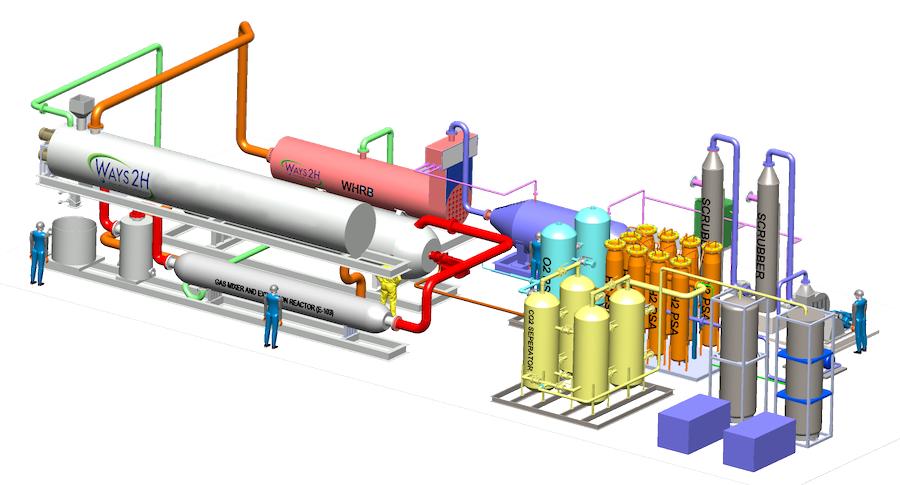
A different architecture for real-world organic feedstocks.
The Platform combines commercially established process equipment in a proprietary configuration. A fraction of produced hydrogen is combusted with oxygen to generate controlled process heat and steam, supporting a steam-saturated environment through the Vapolyser, high-temperature Reformer and water-gas-shift stages.
The gasification zone operates without oxygen injection. The process is designed to avoid char production and maximize conversion of feedstock carbon into a separable CO₂ stream for sequestration or beneficial use.
Modular from validation to commercial deployment.
Ways2H scales through repeatable modules rather than a single very large reactor. This supports distributed projects and phased capacity additions.
Actual mass balance, utility demand, product specification and economics are established during Project Assessment for the selected feedstock, site and end use.
Designed for carbon-containing solids that are difficult to valorize conventionally.
Representative feedstocks
Suitable material is chemically organic and preprocessed to the project specification. The Platform generally requires moisture at or below 20%.
Primary outputs
- Hydrogen for mobility, industrial use, power generation or other local applications.
- CO₂ as a concentrated stream for sequestration or project-specific utilization.
- Carbon-derived products may be added downstream where technically and commercially justified, including mineralization or carbon-material pathways.
Downstream configuration is selected project by project; Ways2H does not assume a universal carbon-product market.
Local infrastructure for waste-constrained and energy-intensive markets.
Communities
Reduce dependence on landfill and long-distance waste transport while creating a local energy product.
Industrial sites
Convert suitable residuals into hydrogen for process use, mobility or power applications.
Remote + island systems
Address high disposal costs and imported-energy exposure with distributed conversion capacity.
Power + data centers
Pair local hydrogen production with fuel cells where dispatchable clean electricity is required.
From project definition to operating asset.
Configuration is site-specific. Feedstock, preprocessing, permitting, hydrogen use, CO₂ pathway, utilities and local economics are resolved before detailed engineering.
Project Definition
Initial objectives, site, feedstock, product use and project boundaries.
Project Assessment
Qualification gate, configuration engineering, mass/energy balance, permitting and commercial basis.
Detailed Engineering
Site-specific engineering, equipment definition, integration and procurement preparation.
Manufacture + Commission
Fabrication, installation, commissioning, operator support, maintenance and remote monitoring.
Hydrogen technology built around circularity and distributed deployment.
Ways2H is the technology subsidiary of Clean Energy Enterprises. We engineer and deliver waste-to-hydrogen systems and support projects from early assessment through commissioning and long-term operation.

Clean Energy Enterprises provides the corporate platform for Ways2H activities and project development.
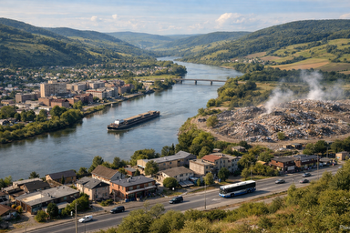
Start with the waste stream and the local hydrogen use.
Ways2H evaluates each opportunity around feedstock characteristics, site conditions, preprocessing needs, product use, carbon pathway and permitting requirements.